RHODIUM*
*AND RHODIUM PLATING
Attention all white gold lovers! Attention silver jewellery lovers!
When buying and caring for your jewellery, it is essential to understand Rhodium plating: what it is, what it does and why you should care.
Rhodium is a white metal of the platinum group. It is extremely rare, corrosion-resistant and very hard. Like most metals used in jewellery, it is mostly used in manufacturing, in this case, cars.
Rhodium was discovered in 1803. It has a melting point of 1964°C, which is higher than platinum.
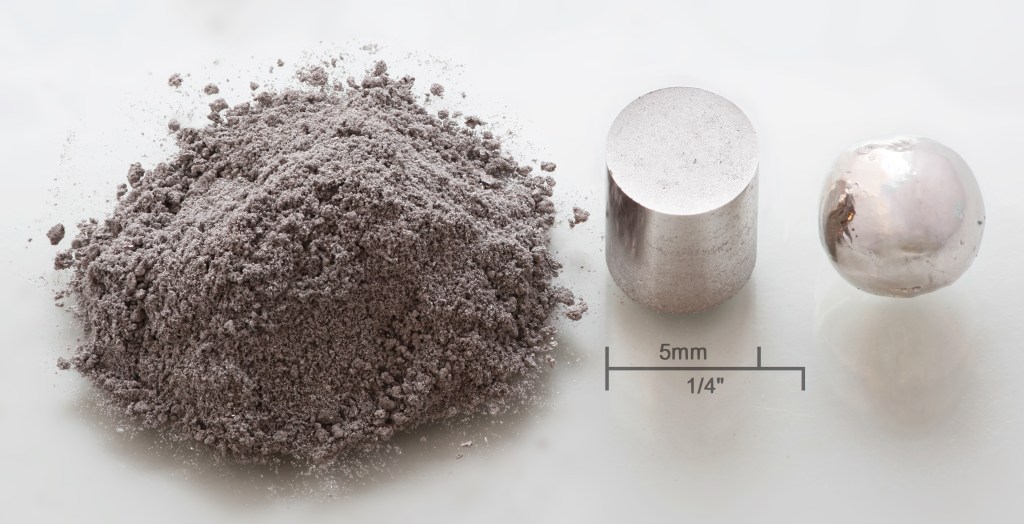
Rhodium weighing 1g powdered, pressed and melted.
Photo Credit: Alchemist-hp (www.pse-mendelejew.de)
Rhodium is not used as a manufacturing metal in jewellery. It is simply too hard, and not malleable enough to use.
What it is used for, and used extensively for, is plating. Plating is where a thin layer of metal is deposited on the piece of jewellery (see the Plating Nugget). While this layer is often usually under a micron thick, due to the hardness of Rhodium it has enormous lasting power. Any thicker than this, and the layer would crack due to the brittleness of rhodium.
If you see jewellery that mentions ‘Rhodium’, it means that it is plated, regardless of whether plating is stated by the seller. If the seller claims that the piece is manufactured itself from rhodium, it is not. At the time of writing (Jan 2024), rhodium is $215 AUD per gram. For reference, Platinum is $49AUD per gram and 24ct Gold $137 AUD per gram. Even if a seller had no object to price, rhodium can’t be formed the same way other metals can.
Rhodium plating is extremely common, at all jewellery price points. At the hig(er)-end, it is used to plate white gold in order to give it the strong white appearance you will know well. It is unlikely you have ever seen un-plated white gold as a consumer, as rhodium plating white gold is the default, and un-plated white gold is not considered conventionally attractive.
Rhodium is also used to plate silver for the same reasons, to give it a corrosive-resistant super white finish. It can also be used to hide fire-scale, which is a common discolouration that happens to sterling silver during the manufacturing process (and is perfectly normal).
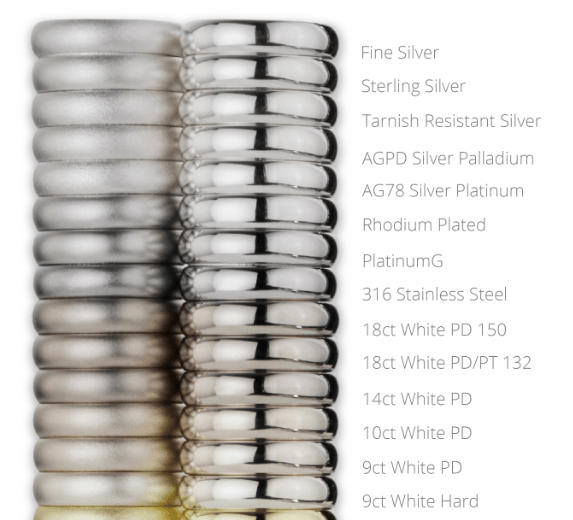
A fantastic comparison of the types of white metal available for jewellery. Note the warm grey tone of the white gold, and the similarity in colour between the Rhodium plate and Platinum.
Source: Chemgold (https://chemgold.com/casting)
Rhodium can also be used to plate base metals, although one would normally see a base metal silver plated, as the cost of rhodium makes plating base metals (e.g. copper and brass) almost pointless.
Plating can have a bad name in jewellery (see our Plating Nugget), but it is not a bad thing unless it is being used to mislead you. Rhodium plating protects the metal, due to its corrosion resistance, and increases the desirability of its appearance.
It does, however, require maintenance.
Rhodium plating will wear off your jewellery over time, especially where it is in contact with the skin (such as inside ring bands). This is completely normal, and simply a part of rhodium plating. The main change will be in the appearance of the piece: you’ll notice the metal underneath will have a different colour. Usually on gold this is much more yellow than the rhodium.
When this happens, you should take your piece to your jeweller to get it replated. This is important to do regularly anyway, especially with high-value pieces, and jewellers all have different time frames. A check and clean is ideally annually, and a re-plate can probably happen every 3 to 5 years, depending on the wear.
Re-plating will have a fee attached, as all the existing plate will have to be polished off, the ring re-polished and then replated. This will leave it looking very much like new, and the jeweller may also tighten any stones that are loose and check the piece over while they have it.
Replating is a matter of personal preference. While the rhodium does protect the piece from corrosion, this is primarily a concern with sterling silver. If the piece is gold, gold already has these properties, it is simply an aesthetic choice.
If you like it better without the plate, feel free to embrace it. If you can’t afford a re-plate right now – don’t worry, you won’t damage the piece (if it’s gold). If the piece is silver, you also won’t technically damage it – it will just be far more likely to discolour faster.
If you don’t like the appearance of the worn plate and don’t really want to replate it, ask your jeweller for a polish and not to replate.
Replating can be expensive, so it is something to take into consideration if purchasing an engagement ring, as it will be an ongoing expense.
Caring for rhodium plating
Rhodium plating does require a bit of care, as does all jewellery. As usual, I would recommend against wearing the jewellery to the gym; while gardening; while washing up; during any activities that make use of your hands like construction. I would also recommend against exposing the piece to chemicals such as cleaning products and try and avoid perfumes and sunscreen directly applied to the piece.
Above all: don’t panic if you see it starting to wear off. This is not a sign of poor quality, it is a sign that you love your jewellery and like to wear it.
More questions? Ask below, or submit with your contact details.
 Real Gems and Little Nuggets
Leave a comment