CARATS OR KARATS*
*NOT CARROTS
What is gold carat? What does it mean, and how is it different to diamond carats? Is karat different to carat? This is a very common question – and one you get as much in manufacturing workshops as on the showroom floor.
Carat refers to two things: the purity of gold, and the weight of a gemstone.
IN SHORT
Gold carat = a measure of the amount of pure gold in the metal
Diamond carat = a measure of the weight of the diamond
Karat, spelt with a K, will usually only refer to the purity of gold, especially in America.
Carat, spelt with a C, can refer to both in Australia and the rest of the world. In North America, Carat with a C will refer to the weight of a gemstone.
In Australia, we typically will use the ‘C’ spelling variant for both. To the casual observer, this can seem confusing, but it is hard to mix the two uses up contextually once one understands what they’re actually referring to.
Carat, as in gold purity, is restricted to a certain set of values. This is the same with carat as diamond weight.
For example, if someone tells me a ring is 375 carats, I know they’re referring to the gold purity – if they are showing me a 375 carat diamond, there would be four layers of security, I would be blindfolded and have been sworn to secrecy. Likewise, if they say their ring is 1.14ct, I would assume they’re referring to the stone – this would be a purity of gold so small, that you wouldn’t be legally able to call it gold.
It’s helpful to understand why this one word refers to two different concepts – and the answer is in its history.
Carat comes to English via Italian, which itself comes via Arabic, which in turn comes from Greek meaning ‘carob seed’. Carob seeds were used to calibrate scales, as it was believed that the seeds of carob trees were of a consistent weight across plants. (This is not actually true – carob seeds vary individually by weight, as well as by species, location etc.)
This lead to carats as a weight measure, and then by way of imperial and metric measurement conversions (troy oz, carat oz, grains etc.) into a maze of differing values.
The diamond carat weight was standardised in 1907, and gold carats wound their way to a consistency due to trade and various laws.
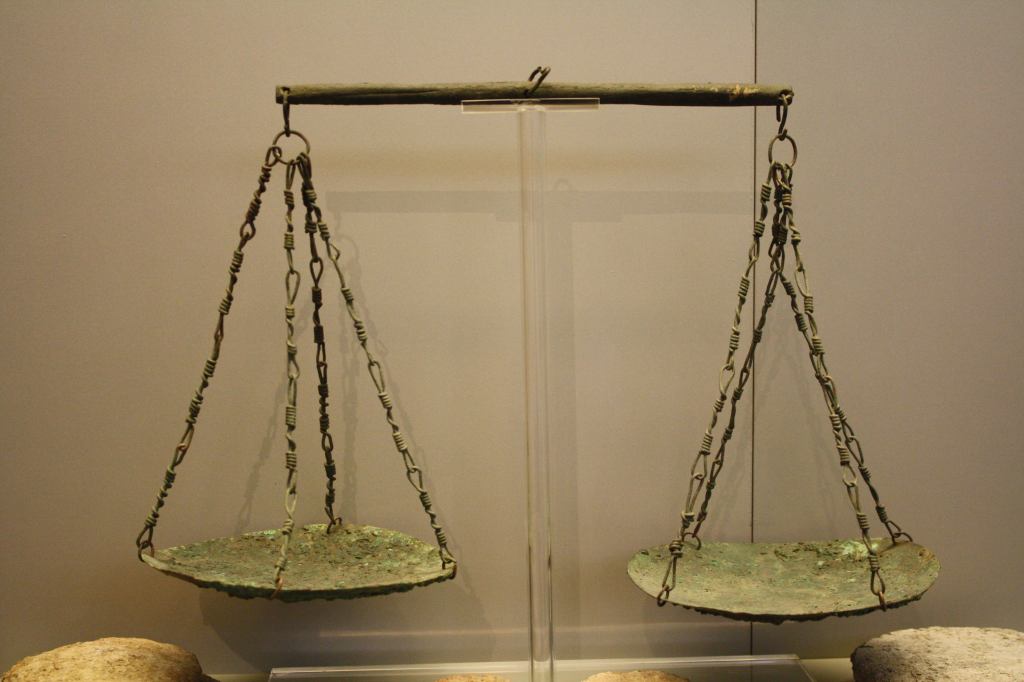
Mycenaen Bronze Scales – A weight standard (e.g. carob seed) would be placed in one side, and the item to be weighed in the other.
Photo Credit: World History Encyclopedia (www.worldhistory.org/image/3735/mycenaean-bronze-scales/)
Carats (the diamond kind)
Carats, when referring to diamonds and other gemstones, is a way of expressing the weight (or mass for our science friends) of the gemstone.
1 carat = 0.2g
This relates to the size of the stone, but not always in the way one expects.
Obviously, the higher the carat, the more the stone weighs and the larger the stone is.
However, the carat only refers to the net weight. As such, the dimensions of the stone can be different. Two one carat stones may be different dimensions depending on their proportions, shape, cut etc.
So, if you see two 1ct diamonds, they will both weight 0.2g, however they may measure differently – a round brilliant cut will appear larger by dimension than a 1ct emerald cut. This is often referred to as ‘face up’ – which means when viewed from the top, as you would in a ring, what the stone looks like.
A comparison of different 1ct diamonds (with a quarter for size comparison)
Photo Credit: Bario Neal (https://bario-neal.com/wp-content/uploads/2022/08/1ct-diamond-cuts-with-dime.jpg)
Why by weight and not size? Well, one needs to look at the supply chain to understand.
Gemstones and diamonds are priced per carat, or by weight. When the stone is bought rough (before cutting), it is bought on the basis of the weight. This is where ‘carat’ comes from – the carob beans used to calibrate scales for determining weight.
That means, even once it is cut, the value of the stone still lies in its weight. We don’t really (except for diamonds) take into consideration the cut of the stone. Obviously, well cut stones will fetch more money, but this is not a straightforward or exponential relationship.
You’ll see some very poorly cut sapphires, designed to retain the maximum weight, and therefore the maximum amount of profit for the seller. These may be more expensive than a smaller, and more beautifully cut, sapphire.
Diamonds are a little different, as the cut is also taken into consideration.
For those who have delved deeper into diamonds, you may also have heard of ‘points’ being used to describe diamond weight.
This is essentially a way of referring to any diamonds below 1ct. A 0.3ct diamond is 30 points, a 0.14ct diamond is 14 points.
If you want to learn more about the size, weight and cut of diamonds and gemstones, we’ll get into this in a different Nugget.
Carats (the gold kind)
Carats, or karats for the North Americans among us, refers to the purity of gold.
Most jewellery is made from alloyed gold – gold that contains a proportion of other metals.
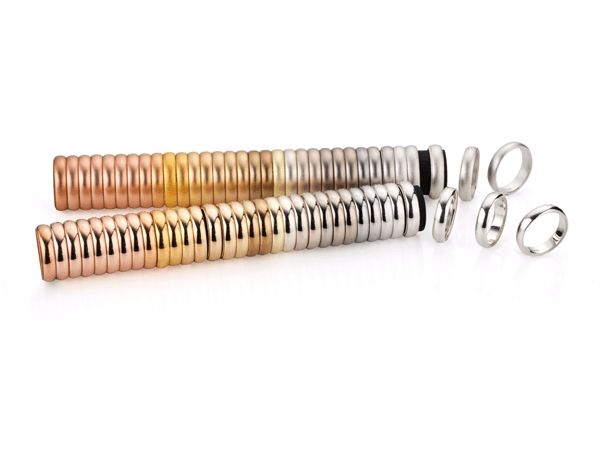
All the rings pictured are various alloys of gold – red gold, pink gold, green gold, yellow gold and white gold
Source: Chemgold (https://chemgold.com/casting)
The purpose of this is to borrow properties from the other metals to offset or compliment the properties of gold (similar to cross breeding plants).
Gold, pure gold, is a bright metallic yellow colour, and extremely malleable and ductile. You can flatten it, shape it and stretch it to a high degree without it breaking. It is also extremely non-reactive – second only to platinum. This means it is quite resistant to acid, tarnish and damage by other elements. This makes it extremely useful for jewellery. It is also very soft. This makes it less useful for jewellery. So, gold is often mixed with other metals, usually silver and copper, to borrow some of their properties. This may be strength, hardness and colour.
The carat refers to the proportion of gold to other metals, and is counted out of 24 parts.
24ct/kt gold is pure gold – 1000/1000 parts or 100%.
These are the main three gold carats used in jewellery in Australia.
| 24ct | 1000/1000 | 100% |
| 18ct | 750/1000 | 75% |
| 14ct | 585/1000 | 58.5% |
| 9ct | 375/1000 | 37.5% |
These alloys represent two things: different physical properties, and different price-points. The lower the proportion of gold in an alloy, the lower the price, as gold is priced by the gram.
Gold is usually alloyed with different proportions of silver and copper. This affects the colour.
This is what’s known as ‘master alloy’ – all you need to do is add pure 24ct gold to these mixes, and you’ll get white, yellow or rose gold.
Source: Pod Jewellery (https://podjewellery.com.au/products/master-alloys-for-jewellery-casting)

So 9ct yellow gold and 9ct rose gold both have the identical proportions of gold in them. It is the other component metals that change. Did you know you can get green gold, red gold and even purple gold (although this isn’t particularly useful for jewellery)?
If you want to learn more about gold colours, carats and its history in jewellery, our upcoming gold real gem is here. We’ll get into hallmarking, fineness, properties and what it all means for the wearer of the jewellery.
Conclusions
To summarise in two sentences?
Gold carat = a measure of the amount of pure gold in the metal
Diamond carat = a measure of the weight of the diamond
More questions? Ask below, or submit with your contact details.
 Real Gems and Little Nuggets

Leave a comment